

 Call us
Seven Hours When Nothing Is Required But Watching
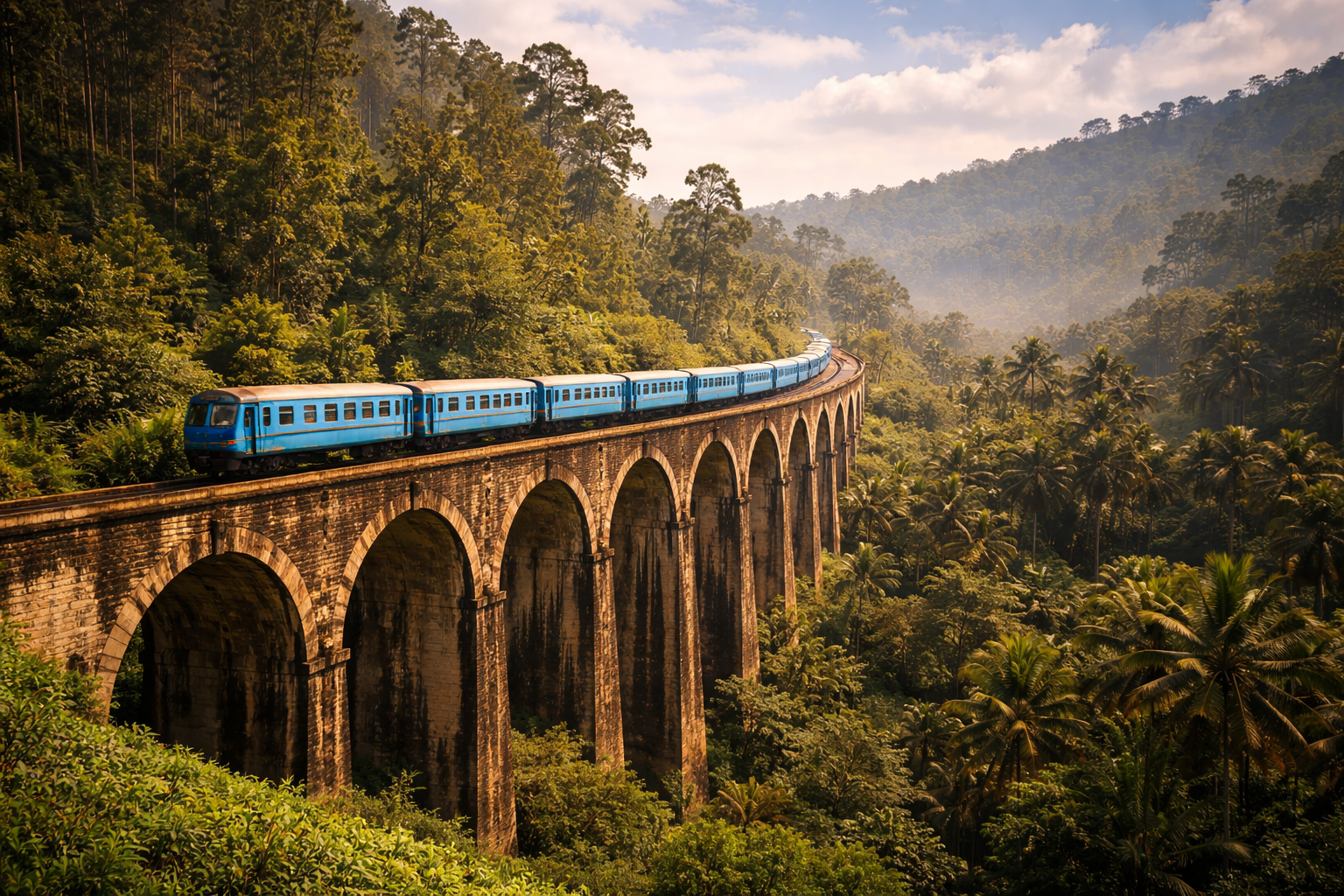
I want to tell you about the moment I knew this train journey was more than transportation.
My father—a man who had checked his phone every fifteen minutes since landing, who worried aloud about every transfer and every temple schedule—was sitting by the window somewhere between Hatton and Haputale. Tea plantations cascaded down hillsides so steep they seemed impossible. Mist wrapped the valleys. The train rocked gently on curves that felt like breathing.
had not spoken in two hours. He had not checked his phone. He was simply watching.
When he finally looked away from the window, his face was different. The tension that had accompanied us since the first temple was gone. The train had done something to him that darshan had not—forced him, through the simple impossibility of hurrying, into presence.
What the Journey Offers
The route runs from Kandy through Sri Lanka's hill country to Ella and Badulla—six to seven hours for the full journey, though shorter segments are possible. From Kandy the train climbs steadily, leaving lowland heat and entering tea country. By Hatton you are fully in the highlands, winding through tunnels bored through solid rock, crossing bridges that hang over valleys, passing tea pickers who wave from impossibly steep slopes.
The famous stretch runs between Nanu Oya (the stop for Nuwara Eliya) and Ella. Here the train crosses the Nine Arch Bridge—you have seen it photographed a thousand times, but the photograph does not capture what it feels like to curve across that stone viaduct with jungle below and children at the window gasping. Here the track performs the Demodara Loop, spiraling around itself to manage the grade, engineering that feels like magic. Here, about thirty minutes before Ella, the views open across valleys to the southern plains, and you understand why people call this one of the world's great train journeys.
How to Make the Journey
Book first-class observation seats well in advance—these carriages appear on certain morning trains from Kandy and offer reserved seating, large windows, and the best vantage points. Second-class reserved provides comfortable travel at lower cost, while third-class unreserved offers the most immersive experience (open windows, local passengers, vendors selling snacks) but cannot be booked and can get crowded.
Bring food and water—the train has vendors but options are limited. Pack layers, because temperature drops dramatically as altitude increases. A light jacket that seemed unnecessary in Kandy becomes essential by Hatton. Bring cameras with charged batteries; you will use them constantly.
The full journey takes most of a day—depart Kandy around nine in the morning, arrive Ella mid-afternoon. This is not time stolen from pilgrimage. This is rest that happens to be beautiful—hours when no one needs to navigate, decide, or perform. Your only task is to watch. For families who have been temple-intensive, the train provides something valuable beyond transport: a day when togetherness requires nothing but shared wonder.